



ATTR Amyloidosis: Wild-Type vs Hereditary ATTR, Symptoms, Diagnosis & Treatment
Transthyretin amyloidosis, or ATTR amyloidosis, is a progressive disease caused by the misfolding and deposition of transthyretin protein as amyloid fibrils in tissues and organs. ATTR amyloidosis occurs in two principal forms: wild-type ATTR (ATTRwt) and variant or hereditary ATTR (ATTRv) (1, 2).
The heart is a major target organ, particularly in ATTRwt and in several ATTRv genotypes. Hereditary ATTR can also prominently involve the peripheral and autonomic nervous systems, producing polyneuropathy or a mixed cardiac-neurological phenotype. Recognizing the disease early is increasingly important because disease-modifying therapies can slow progression (1).
What Is Transthyretin?
Transthyretin, abbreviated TTR, is a transport protein produced predominantly by the liver. Under normal conditions, four TTR protein subunits associate to form a stable tetramer.
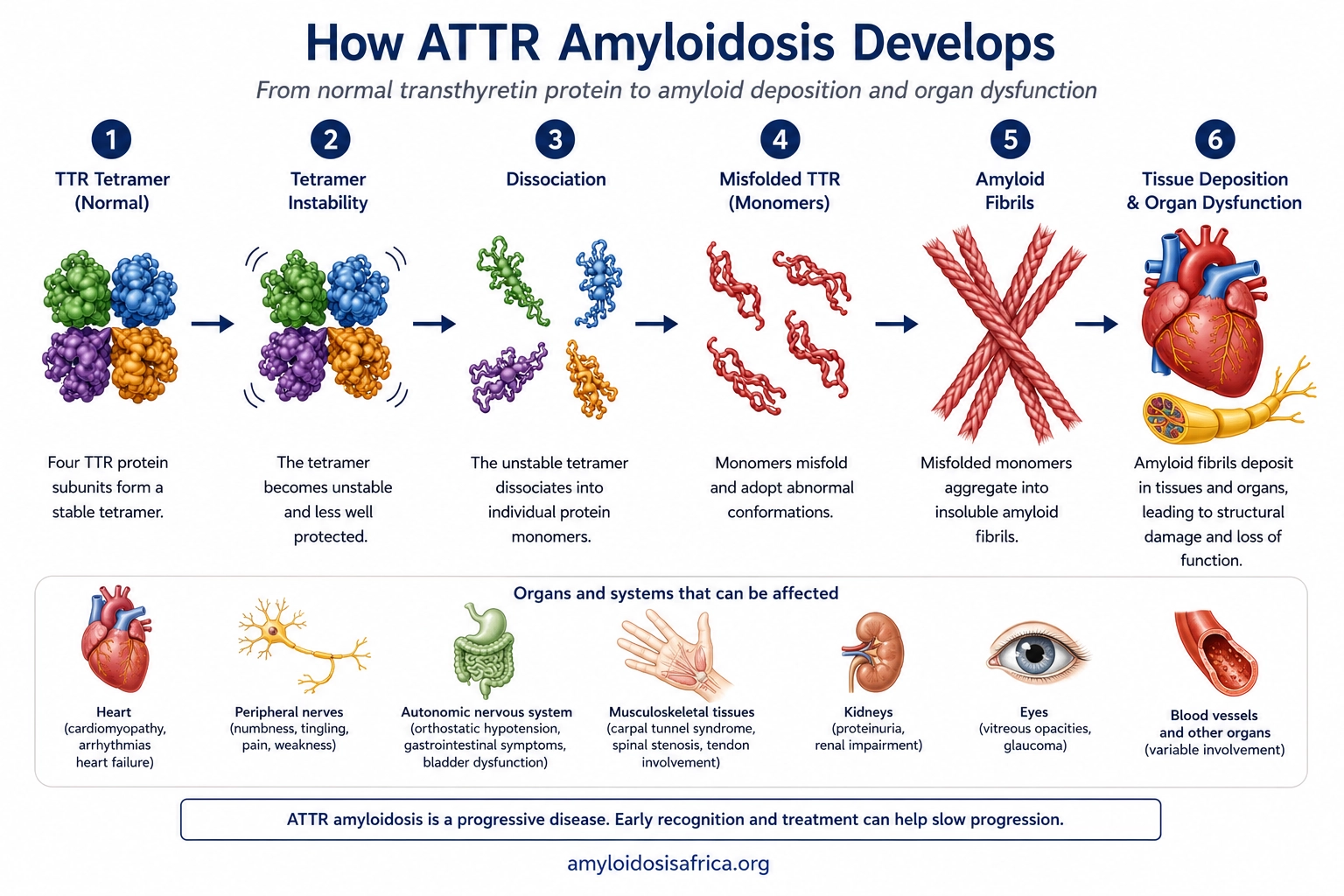
In ATTR amyloidosis, the TTR tetramer becomes unstable and dissociates. Individual protein subunits can then misfold, aggregate, and ultimately form amyloid fibrils that accumulate within tissues (5).
How ATTR amyloidosis develops
TTR tetramer → Tetramer instability → Dissociation into monomers → Protein misfolding → Amyloid fibril formation → Tissue deposition → Organ dysfunction
What Are the Two Types of ATTR Amyloidosis?
ATTR amyloidosis is classified according to whether the patient carries a disease-associated variant in the TTR gene (1, 2).
Wild-Type ATTR Amyloidosis (ATTRwt)
Wild-type ATTR amyloidosis occurs without a pathogenic TTR gene variant. It is predominantly recognized in older adults and most commonly presents as transthyretin amyloid cardiomyopathy (1, 2).
Several musculoskeletal manifestations may occur years before cardiac amyloidosis becomes clinically apparent, including:
- Bilateral carpal tunnel syndrome
- Lumbar spinal stenosis
- Spontaneous distal biceps tendon rupture
These musculoskeletal conditions are common in the general population and are not diagnostic of ATTR amyloidosis on their own. Their significance increases when they occur together with a compatible cardiac phenotype.
Hereditary or Variant ATTR Amyloidosis (ATTRv)
ATTRv amyloidosis results from a pathogenic or likely pathogenic variant in the TTR gene. It is inherited in an autosomal dominant manner, although the presence of a pathogenic variant does not mean that every carrier will develop clinically apparent disease.
Age at onset, penetrance, and organ involvement vary substantially according to the specific variant and other genetic, geographic, and potentially environmental factors (1).
ATTRv may present predominantly as:
- Cardiomyopathy
- Polyneuropathy
- A mixed cardiac and neurological phenotype
ATTRwt vs ATTRv: Key Differences
Which Organs Can ATTR Amyloidosis Affect?
The clinical manifestations of ATTR amyloidosis depend on the organs involved and, in hereditary disease, the underlying TTR variant.
Major organ systems
- Heart: cardiomyopathy, heart failure, arrhythmias and conduction disease
- Peripheral nerves: sensory and motor polyneuropathy
- Autonomic nervous system: orthostatic hypotension, gastrointestinal dysmotility and other autonomic symptoms
- Musculoskeletal tissues: carpal tunnel syndrome, spinal stenosis and tendon involvement
- Other tissues: involvement depends on genotype and phenotype
Cardiac Involvement
When amyloid fibrils accumulate in the myocardium, the ventricular walls become progressively thickened and stiff. This can impair ventricular relaxation, increase filling pressures and ultimately result in heart failure.
Potential manifestations include:
- Progressive shortness of breath
- Reduced exercise tolerance
- Fatigue
- Peripheral oedema
- Atrial fibrillation
- Conduction disease
- Syncope or presyncope
Peripheral Neuropathy
Neurological involvement is particularly important in ATTRv. Symptoms can include:
- Numbness
- Tingling or burning sensations
- Neuropathic pain
- Progressive sensory loss
- Muscle weakness in more advanced disease
Autonomic Dysfunction
- Orthostatic hypotension
- Early satiety
- Diarrhoea or constipation
- Altered gastrointestinal motility
- Bladder dysfunction
- Sexual dysfunction
What Red Flags Should Raise Suspicion for ATTR Amyloidosis?
ATTR amyloidosis should be considered when several compatible cardiac, neurological or musculoskeletal findings occur together (1, 2).
- Unexplained increased ventricular wall thickness
- Heart failure with preserved or mildly reduced ejection fraction in an appropriate clinical setting
- Atrial fibrillation
- Conduction disease or pacemaker requirement
- Bilateral carpal tunnel syndrome
- Lumbar spinal stenosis
- Spontaneous distal biceps tendon rupture
- Peripheral or autonomic neuropathy
- Family history of amyloidosis, neuropathy, or otherwise unexplained cardiomyopathy
Red flags increase suspicion but do not establish the diagnosis. ATTR amyloidosis should be confirmed using an appropriate diagnostic pathway.
How Is ATTR Cardiac Amyloidosis Diagnosed?
The diagnostic approach combines clinical suspicion, cardiac imaging, assessment for a monoclonal immunoglobulin and, where appropriate, bone-avid tracer scintigraphy or tissue biopsy (1, 2).
Step 1: Evaluate for a Monoclonal Protein
When cardiac amyloidosis is suspected, assessment for AL amyloidosis is essential. Recommended testing includes:
- Serum free light-chain assay
- Serum immunofixation electrophoresis
- Urine immunofixation electrophoresis
A positive bone scintigraphy scan alone is not sufficient to diagnose ATTR-CM. AL amyloidosis may also demonstrate cardiac tracer uptake, so monoclonal protein testing is an essential part of the non-biopsy ATTR pathway.
Step 2: Cardiac Imaging
Echocardiography and cardiac magnetic resonance can identify findings that support the presence of cardiac amyloidosis, but imaging alone generally cannot definitively establish whether the amyloid type is ATTR or AL (2).
Step 3: Bone-Avid Tracer Scintigraphy
Validated bone-avid tracers include 99mTc-PYP, 99mTc-DPD and 99mTc-HMDP.
In a patient with a compatible cardiac phenotype, grade 2 or 3 cardiac tracer uptake together with the absence of a monoclonal protein can establish ATTR-CM noninvasively (3).
When Is Biopsy Needed?
Tissue biopsy and definitive amyloid typing may be required when the non-biopsy diagnostic criteria are not fulfilled, when test results are discordant, or when a monoclonal gammopathy creates uncertainty about the amyloid type (1, 2).
Why Is Genetic Testing Important After ATTR Is Diagnosed?
Once ATTR amyloidosis is established, TTR genetic testing is recommended to distinguish hereditary ATTRv from ATTRwt (1, 2).
Genetic testing remains important even when the patient is older, and the phenotype initially appears consistent with wild-type disease. A confirmed pathogenic TTR variant has implications for genetic counselling and potentially for biological relatives.
Finding a pathogenic TTR variant is not the same as diagnosing symptomatic amyloidosis in a relative. Clinical penetrance is incomplete and varies by variant, age and other factors.
A Simplified ATTR-CM Diagnostic Pathway
Suspected cardiac amyloidosis
Clinical red flags + ECG + echocardiography ± CMR
↓
Monoclonal protein assessment
Serum free light chains + serum immunofixation + urine immunofixation
↓
If ATTR-CM remains suspected
Perform validated bone-avid tracer scintigraphy
↓
Grade 2/3 uptake + no monoclonal protein
ATTR-CM may be diagnosed noninvasively in the appropriate clinical context
↓
If criteria are not met or results are discordant
Specialist assessment ± tissue biopsy and definitive amyloid typing
↓
ATTR confirmed
TTR genetic testing → ATTRv or ATTRwt
This pathway is a simplified educational overview and should be interpreted within the individual clinical context (1, 2, 3).
How Is ATTR Amyloidosis Treated?
Modern ATTR therapy aims to interfere with the disease process by either stabilizing circulating transthyretin or reducing hepatic production of TTR. Treatment selection depends on phenotype, disease severity, comorbidities, approved indications and local availability.
TTR Stabilization
TTR stabilizers bind to transthyretin and reduce dissociation of the tetramer into amyloid-forming monomers.
In the ATTR-ACT trial, tafamidis reduced all-cause mortality and cardiovascular-related hospitalizations compared with placebo in patients with ATTR-CM (5).
The ATTRibute-CM trial demonstrated clinical benefit with the TTR stabilizer acoramidis across a hierarchical outcome incorporating mortality, cardiovascular hospitalization, NT-proBNP and functional capacity (6).
Reduction of TTR Production
TTR-silencing therapies reduce production of transthyretin by the liver.
In the HELIOS-B trial, vutrisiran reduced the risk of all-cause death and recurrent cardiovascular events and preserved functional capacity and health status compared with placebo in patients with ATTR-CM (7).
Regulatory approval and access differ between countries. Treatment decisions should follow locally applicable regulatory guidance and be individualized according to the patient’s phenotype, disease stage and clinical circumstances.
Supportive and Multidisciplinary Care
Disease-modifying treatment does not replace management of organ complications. Care may include:
- Management of congestion and heart failure symptoms
- Assessment and management of arrhythmias
- Management of conduction disease
- Neuropathic symptom management
- Management of orthostatic hypotension and autonomic dysfunction
- Physiotherapy and rehabilitation when appropriate
- Genetic counselling in ATTRv
ATTR Amyloidosis in Africa
ATTR amyloidosis has particular relevance to African populations because the TTR p.Val142Ile variant, historically referred to as V122I, has important ancestral origins in West Africa.
A genetic study of samples from multiple African populations found the variant at its highest frequencies in a group of contiguous West African countries, while substantial geographic variation was observed across the continent (4).
Carrier frequency is not the same as disease prevalence. Not every person carrying p.Val142Ile develops clinically manifest ATTR amyloidosis, and the true burden of symptomatic ATTR-CM in individual African countries cannot be inferred directly from genetic carrier frequencies.
Priorities for ATTR amyloidosis in Africa include:
- Increasing clinical awareness of ATTR red flags
- Improving access to echocardiography and strain imaging
- Strengthening access to complete monoclonal protein testing
- Expanding access to validated bone-avid tracer scintigraphy where feasible
- Improving TTR genetic testing and genetic counselling capacity
- Improving access to disease-modifying treatment
- Characterizing African TTR variants and phenotypes
- Developing African registries and multicentre research networks
Why Does Early Diagnosis Matter?
ATTR amyloidosis is progressive. Once substantial cardiac or neurological damage has developed, complete reversal may not be possible. Earlier recognition creates an opportunity to confirm the diagnosis, establish whether the disease is hereditary, begin appropriate disease-modifying treatment and manage organ complications before advanced dysfunction develops.
Key Takeaways
- ATTR amyloidosis is caused by misfolding and deposition of transthyretin.
- ATTR occurs as wild-type ATTR (ATTRwt) or hereditary/variant ATTR (ATTRv).
- ATTRwt occurs without a pathogenic TTR variant and predominantly presents with cardiomyopathy.
- ATTRv is caused by a pathogenic TTR variant and may produce cardiac, neurological or mixed disease.
- Bilateral carpal tunnel syndrome, lumbar spinal stenosis and distal biceps tendon rupture can precede ATTR-CM.
- Peripheral and autonomic neuropathy are important clues, particularly in ATTRv.
- Appropriate monoclonal protein testing is required when evaluating suspected cardiac amyloidosis.
- Grade 2 or 3 cardiac uptake on validated bone scintigraphy plus absence of a monoclonal protein can establish ATTR-CM noninvasively in the appropriate clinical context.
- TTR genetic testing should follow confirmed ATTR to distinguish ATTRv from ATTRwt.
- Disease-modifying strategies include TTR stabilization and reduction of TTR production.
- The p.Val142Ile variant has important West African ancestry, but carrying the variant does not necessarily mean that clinical amyloidosis will develop.
- More African epidemiological, genetic and clinical data are needed to define the true burden and phenotype of ATTR amyloidosis across the continent.
References
- Kittleson MM, Ruberg FL, Ambardekar AV, Brannagan TH 3rd, Cheng RK, Clarke JO, et al. 2023 ACC Expert Consensus Decision Pathway on comprehensive multidisciplinary care for the patient with cardiac amyloidosis. J Am Coll Cardiol. 2023;81(11):1076-1126. doi:10.1016/j.jacc.2022.11.022.
- Garcia-Pavia P, Rapezzi C, Adler Y, Arad M, Basso C, Brucato A, et al. Diagnosis and treatment of cardiac amyloidosis: a position statement of the ESC Working Group on Myocardial and Pericardial Diseases. Eur Heart J. 2021;42(16):1554-1568. doi:10.1093/eurheartj/ehab072.
- Gillmore JD, Maurer MS, Falk RH, Merlini G, Damy T, Dispenzieri A, et al. Nonbiopsy diagnosis of cardiac transthyretin amyloidosis. Circulation. 2016;133(24):2404-2412. doi:10.1161/CIRCULATIONAHA.116.021612.
- Jacobson DR, Alexander AA, Tagoe C, Garvey WT, Williams SM, Tishkoff S, et al. The prevalence and distribution of the amyloidogenic transthyretin (TTR) V122I allele in Africa. Mol Genet Genomic Med. 2016;4(5):548-556. doi:10.1002/mgg3.231.
- Maurer MS, Schwartz JH, Gundapaneni B, Elliott PM, Merlini G, Waddington-Cruz M, et al. Tafamidis treatment for patients with transthyretin amyloid cardiomyopathy. N Engl J Med. 2018;379(11):1007-1016. doi:10.1056/NEJMoa1805689.
- Gillmore JD, Judge DP, Cappelli F, Fontana M, Garcia-Pavia P, Gibbs S, et al. Efficacy and safety of acoramidis in transthyretin amyloid cardiomyopathy. N Engl J Med. 2024;390(2):132-142. doi:10.1056/NEJMoa2305434.
- Fontana M, Berk JL, Gillmore JD, Witteles RM, Grogan M, Drachman B, et al. Vutrisiran in patients with transthyretin amyloidosis with cardiomyopathy. N Engl J Med. 2025;392(1):33-44. doi:10.1056/NEJMoa2409134.
Medical Disclaimer
This article is intended for educational and informational purposes and is not a substitute for individualized medical advice, diagnosis or treatment. Diagnostic and treatment decisions should be made by appropriately qualified healthcare professionals based on the individual patient’s circumstances, locally applicable clinical guidance and regulatory approvals.

Leave a Reply