



Genetic Testing in Transthyretin Cardiac Amyloidosis
Genetic testing in transthyretin cardiac amyloidosis is essential for distinguishing hereditary transthyretin amyloidosis (ATTRv) from wild-type transthyretin amyloidosis (ATTRwt). Once ATTR amyloidosis has been established, identifying whether a pathogenic or likely pathogenic variant is present in the TTR gene has implications not only for the patient but also for biological relatives (1, 2).
Hereditary ATTR amyloidosis is caused by disease-associated variants in the TTR gene. These variants destabilize the transthyretin protein and increase its tendency to misfold and form amyloid fibrils. Depending on the variant, affected individuals may develop predominantly cardiomyopathy, predominantly polyneuropathy, or a mixed cardiac and neurologic phenotype (2).
Importantly, the absence of a known family history does not exclude hereditary ATTR amyloidosis. Age-dependent penetrance, incomplete recognition in previous generations, small family size, and variable clinical expression can all obscure an inherited pattern (2).
Key principle: Once ATTR amyloidosis is diagnosed, genetic testing should be performed to determine whether the patient has hereditary ATTR (ATTRv) or wild-type ATTR (ATTRwt), because a pathogenic TTR variant has important implications for family members.
What Is the TTR Gene?
The TTR gene provides instructions for producing transthyretin, a transport protein synthesized mainly in the liver. Transthyretin circulates as a tetramer and transports thyroxine and retinol-binding protein.
In ATTR amyloidosis, transthyretin tetramers become unstable, dissociate into monomers, misfold, and aggregate into amyloid fibrils. These fibrils can deposit in the heart, peripheral nerves, autonomic nervous system, and other tissues.
In hereditary ATTR amyloidosis, a pathogenic or likely pathogenic TTR variant increases this tendency toward protein instability and amyloid formation (2).
ATTRv Versus ATTRwt: Why Genetic Testing Matters
Hereditary ATTR Amyloidosis (ATTRv)
ATTRv occurs when an individual carries a pathogenic or likely pathogenic variant in the TTR gene. The phenotype can vary considerably between variants and even among members of the same family.
Some individuals develop predominantly cardiac disease, while others develop peripheral and autonomic neuropathy. Many patients have a mixed phenotype (2).
Wild-Type ATTR Amyloidosis (ATTRwt)
ATTRwt occurs when structurally normal transthyretin becomes unstable and forms amyloid with increasing age. Patients with ATTRwt do not have a disease-causing TTR variant.
Therefore, genetic testing distinguishes the two forms:
ATTR confirmed
↓
TTR genetic testing
Pathogenic / likely pathogenic TTR variant identified
→ ATTRv
No pathogenic TTR variant identified
→ ATTRwt in the appropriate clinical context
↓
TTR genetic testing
Pathogenic / likely pathogenic TTR variant identified
→ ATTRv
No pathogenic TTR variant identified
→ ATTRwt in the appropriate clinical context
Who Should Have TTR Genetic Testing?
The ACC recommends genetic testing in individuals with clinical evidence supporting a TTR-related phenotype (1).
In clinical practice, genetic testing is particularly important in:
- Patients with confirmed ATTR cardiac amyloidosis
- Patients with ATTR amyloidosis and peripheral or autonomic neuropathy
- Patients with a family history of ATTR amyloidosis
- Patients with unexplained cardiomyopathy plus a family history of heart failure, neuropathy, sudden cardiac death, or amyloidosis
- Relatives of a patient with a known pathogenic or likely pathogenic TTR variant, following appropriate genetic counseling
Because hereditary disease can present late in life, advanced age should not automatically be used to exclude genetic testing.
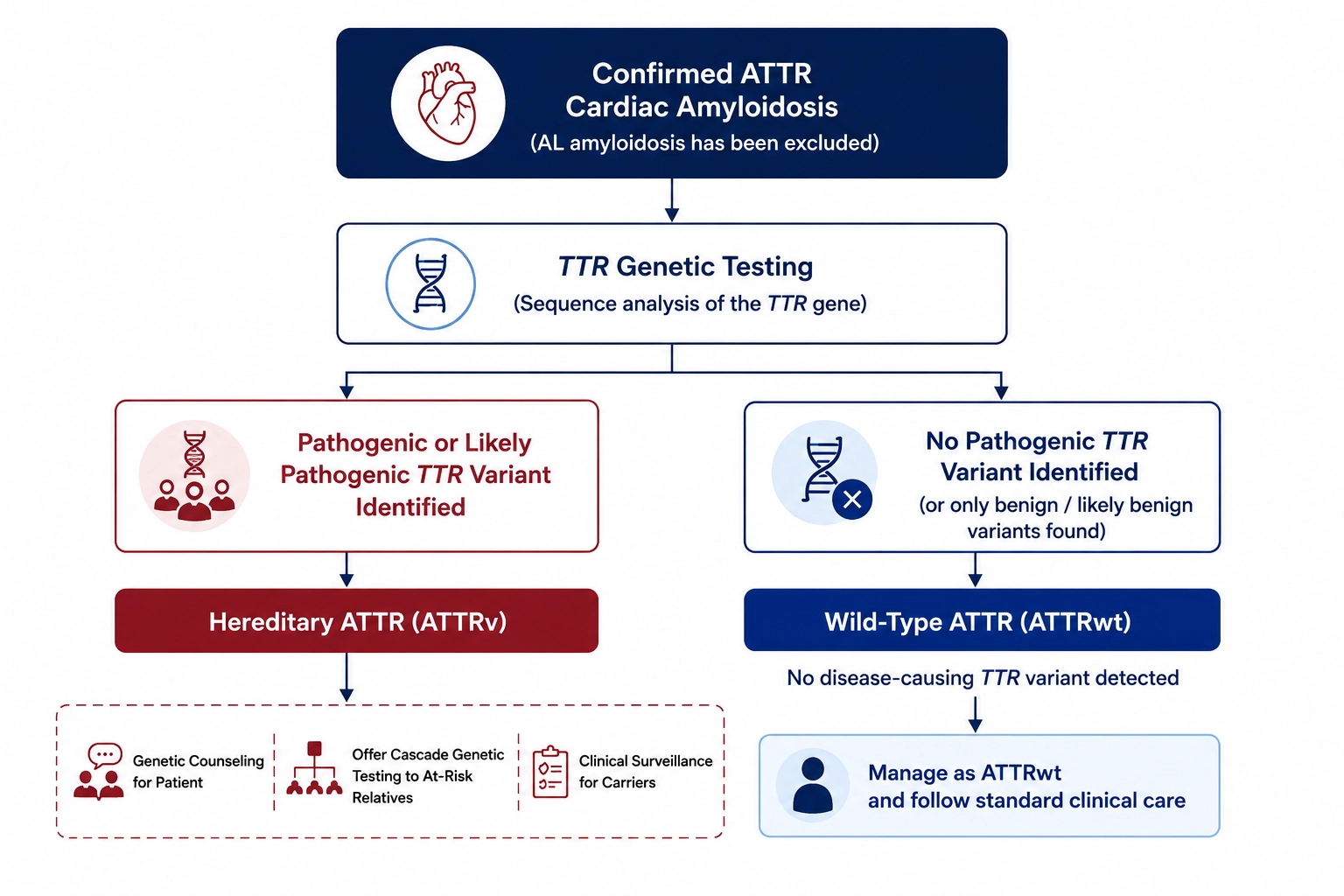
Figure 1. Genetic Testing Pathway in Transthyretin Cardiac Amyloidosis. Following confirmation of ATTR cardiac amyloidosis, TTR genetic testing is used to distinguish hereditary ATTR (ATTRv) from wild-type ATTR (ATTRwt). Identification of a pathogenic or likely pathogenic TTR variant establishes ATTRv and has important implications for genetic counseling, cascade testing of at-risk relatives, and surveillance of variant carriers.
How Is TTR Genetic Testing Performed?
Genetic testing usually analyzes DNA obtained from a blood or saliva sample. The laboratory then examines the TTR gene for sequence variants.
For a patient with an established ATTR phenotype, sequence analysis of the TTR gene is generally the most direct test. Sequence analysis detects the types of pathogenic variants responsible for ATTRv, including missense, nonsense, splice-site, and small insertion or deletion variants (2).
GeneReviews reports that sequence analysis identifies all known disease-causing TTR sequence variants essentially, whereas large deletions or duplications are not recognized as an important mechanism of hereditary ATTR amyloidosis (2).
Single-Gene Testing Versus Multigene Panels
TTR Single-Gene Testing
When the phenotype already strongly supports ATTR amyloidosis, testing the TTR gene directly is often appropriate. This focused approach reduces the likelihood of identifying unrelated variants that may complicate interpretation.
Multigene Cardiomyopathy or Neuropathy Panels
A broader gene panel may be appropriate when the phenotype is uncertain or when another inherited cardiomyopathy or neuropathy remains in the differential diagnosis.
If a multigene panel is used to investigate suspected ATTR, clinicians should confirm that TTR is included. The ACC also recommends using phenotype-focused panels where possible to reduce unnecessary variants of uncertain significance (1).
How Are Genetic Test Results Classified?
Clinical genetic laboratories generally classify sequence variants according to standardized categories:
- Pathogenic
- Likely pathogenic
- Variant of uncertain significance (VUS)
- Likely benign
- Benign
Pathogenic or Likely Pathogenic Variant
When an individual with ATTR amyloidosis has a pathogenic or likely pathogenic TTR variant, the diagnosis is classified as hereditary ATTR amyloidosis (ATTRv) (2).
Variant of Uncertain Significance
A variant of uncertain significance (VUS) means that available evidence is currently insufficient to determine whether the variant causes disease.
A VUS should not be treated as equivalent to a pathogenic variant. Importantly, the ACC states that variants of uncertain significance should not be used for cascade testing of relatives (1).
Important: A variant of uncertain significance does not establish hereditary ATTR amyloidosis and should not be used to predict disease risk in relatives.
How Is Hereditary ATTR Amyloidosis Inherited?
Hereditary ATTR amyloidosis follows an autosomal dominant inheritance pattern (2).
This means that an individual who carries one pathogenic TTR variant can pass that variant to either sons or daughters.
A heterozygous carrier has a 50% chance of passing the familial TTR variant to each child.
However, inheriting a pathogenic variant does not necessarily mean that a person will develop clinically apparent amyloidosis at the same age, with the same organ involvement, or with the same severity as another family member. This phenomenon reflects variable penetrance and variable expression (1, 2).
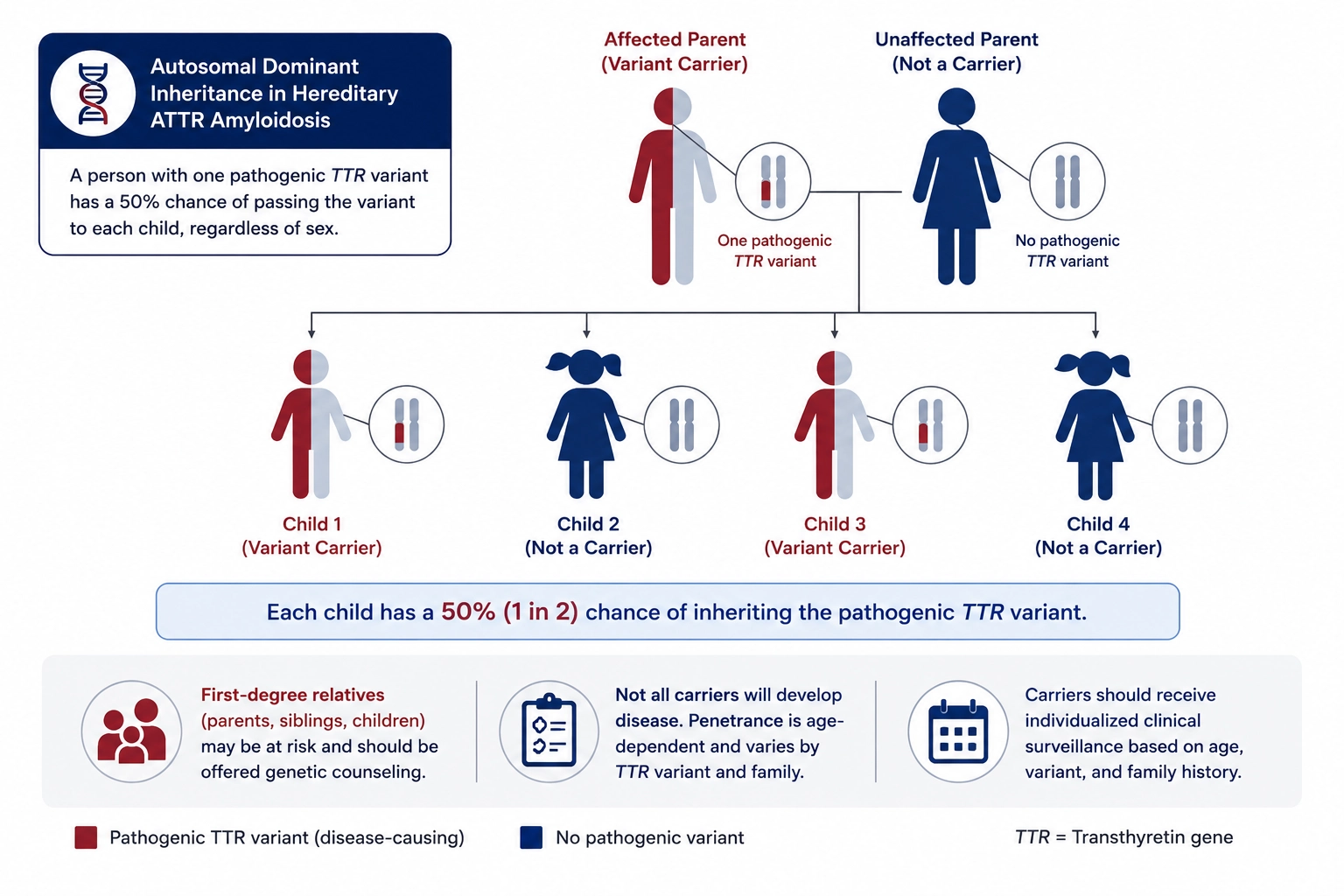
Figure 2. Autosomal Dominant Inheritance in Hereditary ATTR Amyloidosis. A pathogenic TTR variant is inherited in an autosomal dominant pattern, meaning each child of a variant carrier has a 50% (1 in 2) chance of inheriting the variant. Not all carriers develop clinical disease because penetrance varies according to the specific TTR variant, age, and family background. Identification of a pathogenic variant therefore has implications for genetic counseling, cascade testing of at-risk relatives, and individualized surveillance of carriers.
What Is Cascade Genetic Testing?
When a pathogenic or likely pathogenic TTR variant is identified in an affected individual, clinicians can offer cascade genetic testing to at-risk relatives (1, 2).
Instead of sequencing many genes again, relatives can usually undergo targeted testing for the specific familial variant already identified in the proband.
First-degree relatives include:
- Parents
- Siblings
- Children
The ACC recommends considering cascade testing in at-risk first-degree relatives when a pathogenic or likely pathogenic variant has been identified (1).
Why Is Genetic Counseling Important?
Genetic testing can have medical, psychological, reproductive, and family implications. Therefore, testing should ideally be accompanied by appropriate genetic counseling.
Genetic counseling can help patients and families understand:
- What the genetic test can and cannot determine
- The difference between carrying a variant and having clinically manifest disease
- The 50% transmission risk associated with autosomal dominant inheritance
- The implications for siblings, children, and other relatives
- The meaning of pathogenic, likely pathogenic, and uncertain variants
- Options for predictive testing
- Potential reproductive considerations
- The need for long-term surveillance if a pathogenic variant is identified
What Happens When an Asymptomatic Relative Tests Positive?
An individual who carries a pathogenic TTR variant but does not yet have clinical evidence of amyloidosis is often referred to as an asymptomatic carrier or pre-symptomatic carrier.
A positive genetic result does not necessarily mean that amyloid deposition or organ dysfunction is already present. Instead, it identifies an individual at increased lifetime risk who may benefit from structured surveillance.
Surveillance may include:
- Clinical assessment for heart failure symptoms
- Electrocardiography
- Echocardiography
- Cardiac biomarkers such as BNP or NT-proBNP
- Assessment for peripheral neuropathy
- Assessment for autonomic dysfunction
- Evaluation for carpal tunnel syndrome or other extracardiac red flags
- Bone scintigraphy or other imaging when clinically appropriate
The timing and intensity of surveillance should consider the specific variant, expected age of onset, phenotype within the family, and individual clinical circumstances (1, 2).
Important TTR Variants and Clinical Phenotypes
Many pathogenic TTR variants have been described. Different variants are associated with different ages of onset and different combinations of cardiac and neurologic disease.
p.Val142Ile
The p.Val142Ile variant, historically known as Val122Ile, is particularly important in populations of African ancestry. It is strongly associated with a predominantly cardiac phenotype that generally becomes clinically apparent later in adulthood (3).
Large studies suggest that approximately 3%–3.5% of people of African descent in well-powered cohorts carry this variant, although prevalence varies geographically (3).
p.Val50Met
The p.Val50Met variant, historically known as Val30Met, is one of the best characterized hereditary ATTR variants. It has been associated particularly with peripheral and autonomic neuropathy, although cardiac involvement can also occur (2).
Terminology note: Variant names may appear differently in older and newer literature. For example, Val122Ile is now commonly designated p.Val142Ile, and Val30Met is commonly designated p.Val50Met, reflecting current protein numbering conventions.
Genetic Testing for ATTR Amyloidosis in Africa
Genetic testing has particular relevance for cardiac amyloidosis in Africa because the p.Val142Ile TTR variant has important ancestral origins in West Africa and remains strongly associated with populations of African descent (3, 4).
Available studies suggest that the variant is especially prevalent in parts of West Africa. However, genetic data from many African populations remain limited, and substantial geographic gaps remain (4).
Important priorities include:
- Improving access to clinical TTR sequencing
- Expanding access to genetic counseling
- Developing referral pathways for relatives of patients with ATTRv
- Increasing awareness of p.Val142Ile and other disease-associated variants
- Generating population-specific genetic data across African regions
- Developing surveillance pathways for asymptomatic carriers
- Ensuring that genetic testing is integrated with cardiac imaging, neurology, and amyloidosis care rather than used in isolation
Improved access to genetic testing could therefore support earlier diagnosis while also helping define the currently under-characterized genetic landscape of ATTR amyloidosis across Africa.
What Genetic Testing Cannot Tell Us
A genetic result must always be interpreted in the clinical context.
Genetic testing alone cannot reliably determine:
- Exactly when a carrier will develop disease
- Whether every carrier will develop clinically significant amyloidosis
- Which organs will be affected first
- How rapidly disease will progress
- The exact clinical severity in an individual patient
Therefore, genetic information should complement rather than replace careful clinical assessment and disease surveillance.
Common Pitfalls in ATTR Genetic Testing
Assuming Older Patients Have ATTRwt
Hereditary ATTR may present late in life. Therefore, advanced age does not reliably distinguish ATTRwt from ATTRv.
Relying on Family History Alone
A negative or unknown family history does not exclude hereditary disease. Variable penetrance and late onset can leave multiple generations undiagnosed.
Treating a VUS as Disease-Causing
A VUS should not be considered equivalent to a pathogenic or likely pathogenic variant and should not be used for predictive testing in relatives.
Testing Relatives Without Counseling
Predictive genetic testing has consequences that extend beyond the laboratory result. At-risk relatives should understand the implications of both positive and negative results before testing whenever possible.
A Practical Genetic Testing Checklist
When evaluating a patient with ATTR amyloidosis, ask:
- Has ATTR amyloidosis been adequately established?
- Has TTR genetic testing been ordered?
- Was the result pathogenic, likely pathogenic, uncertain, or benign?
- Does the variant fit the patient’s phenotype?
- Has the patient received genetic counseling?
- Have first-degree relatives been informed about the potential implications?
- If the variant is pathogenic or likely pathogenic, has cascade testing been discussed?
- If a relative tests positive, is a structured surveillance plan available?
- Has a VUS been avoided as the basis for predictive family testing?
Key Takeaways
- TTR genetic testing distinguishes hereditary ATTR (ATTRv) from wild-type ATTR (ATTRwt).
- Genetic testing is important even in older patients and in patients without a known family history.
- A pathogenic or likely pathogenic TTR variant supports the diagnosis of ATTRv in a patient with an appropriate ATTR phenotype.
- Hereditary ATTR amyloidosis follows an autosomal dominant inheritance pattern.
- Each child of a heterozygous carrier has a 50% chance of inheriting the familial variant.
- A variant of uncertain significance does not establish hereditary disease and should not be used for cascade testing.
- First-degree relatives should be considered for counseling and targeted testing when a pathogenic familial variant is identified.
- Asymptomatic carriers require individualized surveillance because penetrance and age of onset vary.
- The p.Val142Ile variant is particularly relevant to populations of African ancestry and frequently produces a predominantly cardiac phenotype.
Conclusion
Genetic testing is an essential component of modern transthyretin amyloidosis care. Once ATTR amyloidosis has been established, sequencing the TTR gene allows clinicians to distinguish hereditary ATTR from wild-type disease and determines whether biological relatives may also be at risk.
However, genetic results require careful interpretation. Pathogenic and likely pathogenic variants can guide clinical and family management, whereas variants of uncertain significance should not be treated as disease-causing. Genetic counseling and structured follow-up are therefore integral to the process.
The practical principle is straightforward: confirm ATTR, determine whether a pathogenic TTR variant is present, and when hereditary disease is identified, extend appropriate counseling, testing, and surveillance to the family.
References
- Kittleson MM, Ruberg FL, Ambardekar AV, et al. 2023 ACC Expert Consensus Decision Pathway on Comprehensive Multidisciplinary Care for the Patient With Cardiac Amyloidosis. Journal of the American College of Cardiology. 2023;81(11):1076–1126. Full article
- Sekijima Y, Nakamura K. Hereditary Transthyretin Amyloidosis. GeneReviews®. Updated May 30, 2024. GeneReviews
- Chandrashekar P, Alhuneafat L, Mannello M, et al. Prevalence and outcomes of p.Val142Ile transthyretin amyloidosis cardiomyopathy: a systematic review. Circulation: Genomic and Precision Medicine. 2021;14(5):e003356. PubMed
- Madu EC, Mezue K. Uneven burden of cardiac amyloidosis in people of African descent: global imbalance in resources and access. BMC Global and Public Health. 2023;1:16. Full article
Medical Disclaimer
This article is intended for educational and informational purposes only and does not replace individualized medical advice or professional genetic counseling. Genetic testing and interpretation should consider the patient’s clinical phenotype, family history, laboratory methodology, variant classification, and applicable local ethical and legal requirements.

Leave a Reply